



Most gate failures don’t start at the lock—they start at the hinge. Bolted hinges vibrate loose, corrode, and eventually betray the entire system, no matter how premium the hardware looks. Custom welded hinges eliminate these vulnerabilities at the source, but the real question is why so few gate installations actually use them. The difference between a gate that holds for decades and one that constantly needs attention often comes down to one overlooked decision made before installation even begins.
Welded Gate Hinge Capacity: Why Weight Matters
Comprehending hinge capacity is fundamental to designing a swing gate that will perform reliably for years. Your welded hinges directly determine whether your gate operates safely under its own weight plus environmental stresses.
Standard residential weld-on hinges support 200–400 lbs per pair, while heavy-duty commercial hinges reach 600–1,000 lbs or more. A 5″ x 4 1/8″ stainless weld-on hinge handles maximum door weights of 1,000 lbs. An 8″ x 7 7/8″ stainless option supports up to 8,000 lbs. For the heaviest applications, a 12″ x 10 5/8″ carbon steel weld-on hinge manages 20,000 lbs maximum. Permanent weld attachment ensures these load ratings remain consistent throughout the hinge’s operational life without degradation.
Industry best practice requires a safety factor of 1.5x to 2x your gate’s actual weight. A 300 lb gate needs combined hinge capacity of 450–600 lbs. This approach protects against wind loads, frequent operation, and impact damage over time. Selecting hinges engineered from robust, high-quality materials also contributes to minimal long-term upkeep, reducing the frequency of maintenance interventions across the gate’s lifespan.
Welded Hinges vs. Bolted: Why One Outlasts the Other
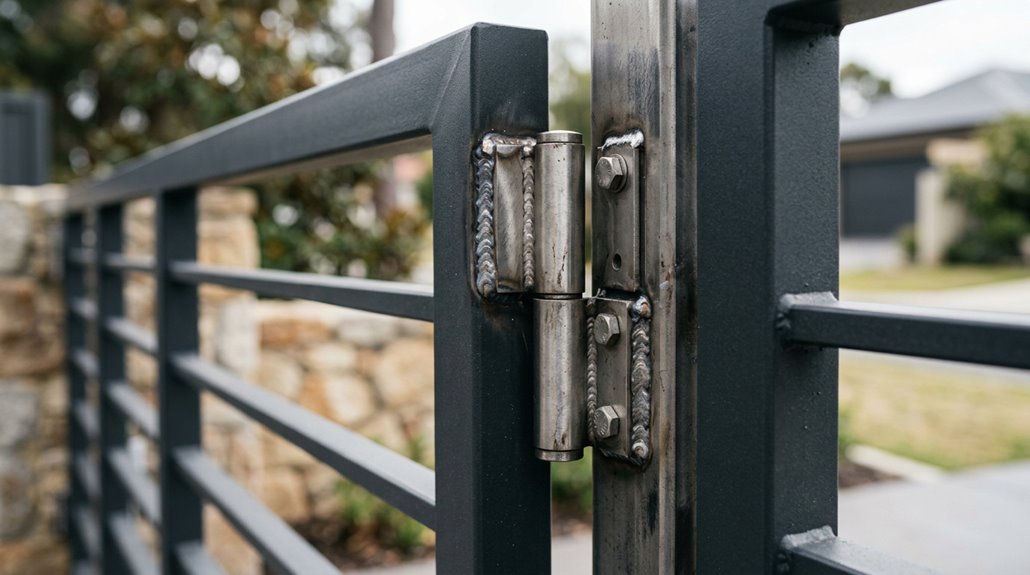
When you choose welded hinges for your security gate, you’re investing in structural integrity that outperforms bolted alternatives by removing mechanical failure points—welded joints transmit forces directly to the door frame, while bolted hinges rely on fasteners that can loosen, pull out, or fail under extreme loads.
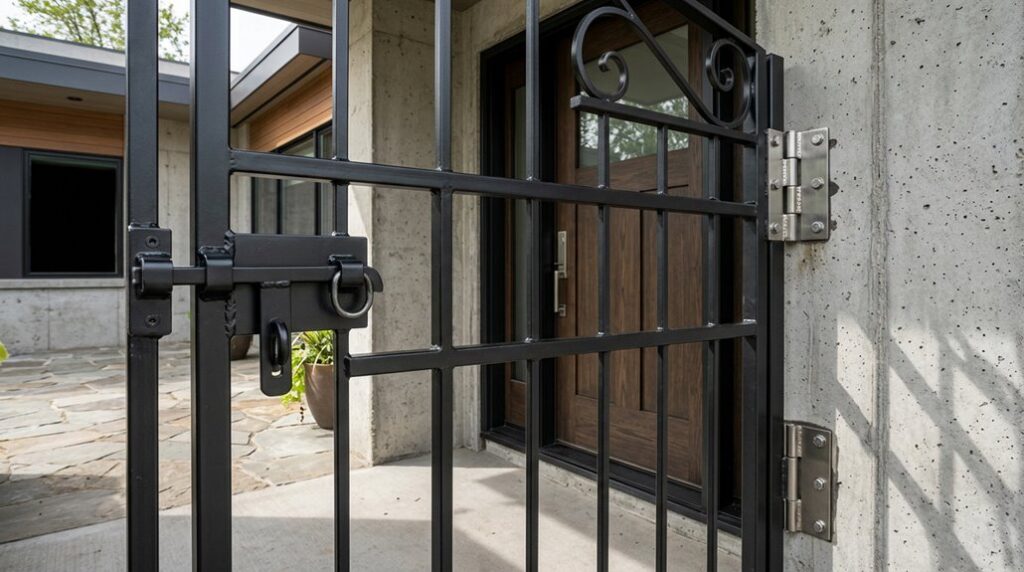
You’ll also benefit from superior tamper resistance because welded designs have no exposed bolts for intruders to cut, unscrew, or manipulate, creating a permanent attachment that becomes part of the frame itself. Weld-on hinges are commonly attached to metal frames and doors, ensuring a unified structure that resists compromise.
Over a 20+ year lifecycle, you’ll spend less on maintenance and repairs because welded hinges can handle 500,000+ open-close cycles without needing the regular tightening and lubrication that bolted systems require. Wonder Bars reinforces this principle through bespoke security installations that prioritise long-term structural performance over cost-cutting shortcuts.
Give your home a grand entrance that keeps uninvited guests strictly on the outside! Check out our master guide on Swing Gates for Doors to see how custom-welded strength can perfectly match your home’s classic style.
Structural Integrity and Longevity
The difference between welded and bolted hinges fundamentally comes down to how they handle the forces placed on your security gate.
Welded hinges create structural continuity by distributing loads evenly across your door frame. This uniform strength distribution eliminates stress concentration points that plague bolted alternatives. You’ll experience superior long-term stability because welded joints become an integral part of the frame itself. Weld-on hinges recommended for loads exceeding 100 kg maintain their structural integrity through impact energy distribution across the weld bead into the parent structure.
Bolted connections concentrate stress at fastener points, creating potential failure zones. Your bolted hinges require periodic inspection and re-tightening to maintain stability under vibration. Choosing security solutions manufactured with SABS and UKAS approved materials ensures that every component, including hinges, meets verified standards for durability and long-term structural performance.
Quality weld-on hinges sustain 500,000+ open-close cycles without structural degradation. Welded joints transmit forces directly to the frame, handling extreme torque and shear loads that bolt-on hinges can’t match.
This means your swing gate remains secure for decades with minimal maintenance.
Tamper Resistance and Security
Security gates face constant pressure from both environmental forces and deliberate tampering attempts, and your hinge choice directly determines how well your installation resists unauthorised removal. Welded hinges eliminate exposed fasteners that invite tampering tools. Bolted alternatives present visible screws requiring additional anti-tamper measures, compromising door security integrity.
| Feature | Welded Hinges | Bolted Hinges |
|---|---|---|
| Exposed Fasteners | None | Visible screws |
| Removal Difficulty | Requires specialist equipment | Basic tools sufficient |
| Tampering Time | Extended | Minimal |
| Security Reliability | Permanent bond | Prone to loosening |
Welded joints transmit forces directly to frames, resisting extreme torque. Bolted systems allow fasteners to loosen under vibration, creating vulnerabilities. Grinding and painting weld seams creates a seamless appearance, hiding the mounting method entirely. You’re delighted to find that welded hinges demand angle grinders or cutting torches for removal—significantly increasing the effort and time required for unauthorised dismantling. The fusion creates higher durability than traditional screw-in hinges, providing long-term tamper resistance without maintenance concerns. Pairing welded hinge construction with superior quality materials further extends gate lifespan while ensuring consistent resistance to both environmental wear and deliberate forced entry attempts.
Choose the Right Hinge Design for Your Swing Direction
When you’re planning your swing gate installation, you’ll need to decide whether you want a left or right swing orientation, which directly affects how your hinges must be positioned and welded to your post and frame.
The pin type and motion forces you select—whether single-acting hinges that move in one direction or double-acting hinges that swing both ways—will determine the structural demands placed on your hinge geometry and load distribution.
Your frame material, whether mild steel, stainless steel, or another compatible metal, must align with your hinge specifications to ensure the connection points can withstand the operational forces your gate encounters through thousands of swing cycles. Working with manufacturers who use SABS and UKAS approved components ensures your hinge and frame materials meet recognised quality and safety standards from the outset.
For uphill slopes, the hinge plane orientation must remain perfectly straight from top to bottom, with the bottom hinge offset downhill by a calculated distance based on your property’s gradient to enable smooth uphill swing operation.
Left vs. Right Swing Orientation
Before you can select the right custom-welded hinges for your swing gate, you’ll need to determine whether your gate swings left or right—and this decision directly affects both the structural integrity and longevity of your security installation.
Stand on the pull side of your gate where it opens towards you. Check which side holds the hinges. Hinges on the left indicate a left-hand swing; hinges on the right indicate a right-hand swing. This orientation determines swing gate safety and helps prevent costly misalignment. For applications that require flexibility, non-handed hinge models are available that can be fitted to either left or right swing orientations without modification.
| Orientation method | What you’ll observe | Resulting classification |
|---|---|---|
| Pull-side positioning | Hinges on left | Left-hand swing |
| Pull-side positioning | Hinges on right | Right-hand swing |
| Back-to-hinge method | Back against hinges | Removes any ambiguity |
Check that the knob position sits opposite the hinges. Matching your hinge design to this orientation ensures the correct motion forces and prevents undue wear on your custom security barriers. A free home consultation with a qualified security specialist can help confirm your gate’s swing orientation and ensure your hinge selection aligns precisely with your property’s structural and aesthetic requirements.
Pin Type And Motion Forces
Once you’ve identified your gate’s swing orientation, the next step is to understand how your hinges will handle the actual forces at work during operation.
Your hinge pins function as revolute joints, constraining motion to pure rotation along a single axis while eliminating sliding or translation. Pin supports generate two reaction forces perpendicular to surfaces, preventing displacement without creating rotational resistance. Unlike fixed supports that resist rotation through a reaction moment, pin supports allow free rotation about their axis while maintaining positional control.
Top hinges carry the highest load, bearing the combined weight distribution plus twisting forces from the gate’s moment. Bottom hinges support only shared weight, without additional twist components. This uneven force distribution directly impacts the durability and longevity of front door security. Selecting high-strength materials for hinge construction ensures the components withstand both mechanical stress and exposure to harsh outdoor conditions.
Custom-welded hinges accommodate these varying forces through precise pin clearances and tolerances. Minimising gaps between components prevents pin bending during rotation. Wonder Bars fabricates hinges engineered specifically for your gate’s weight, swing direction, and operational demands, ensuring reliable performance across South African climate conditions.
Frame Material Compatibility Matters
Your gate’s frame material—whether steel, aluminium, wood or composite—fundamentally determines which hinge design will work best for your installation. Metal frames require weld-on hinges exclusively, as their attachment strength supports heavy gates reliably. Wooden and composite frames can accept screw-on strap, butt or barrel hinges without complications. Hinge visibility and plate dimensions may affect your frame design and clearance requirements, so measure your frame thickness before finalising your hinge choice.
| Frame Material | Recommended Hinge Type | Load Capacity | Corrosion Resistance |
|---|---|---|---|
| Steel | Weld-on hinges | Heavy-duty | Rustproof coating required |
| Aluminium | Weld-on hinges | Heavy-duty | Naturally corrosion-resistant |
| Wood | Surface-mounted strap hinges | Light to medium | Weather-treated steel |
| Composite | Screw-on barrel hinges | Medium | Stainless steel preferred |
| Mixed materials | Heavy-duty pintle hinges | Heavy-duty | Rustproof materials mandatory |
Matching your hinge selection to your frame material prevents mechanical failure and guarantees long-term durability. Your gate’s performance depends on this critical compatibility decision. For tailored recommendations specific to your property, a personalised security quote from a local specialist can help you identify the right hinge and frame combination before installation begins.
Install and align your hinge for smooth gate movement
Proper hinge installation determines whether your gate will operate smoothly for years or develop problems within months.
Proper hinge installation determines whether your gate will operate smoothly for years or develop problems within months.
You’ll position the top hinge 100–200mm from the top of the gate and the bottom hinge 100–300mm from the bottom.
For gates exceeding 1.8m in height, fit a third hinge at the midpoint.
Use a spirit level or a digital laser level to check that the hinges are perfectly vertically aligned.
This precision matters especially for burglar bars KZN installations, where security performance depends on structural integrity.
Start by inserting only one screw per hinge.
This lets you test the gate’s movement before fully installing everything.
Adjust the tension on adjustable hinges to ensure smooth operation.
Use a 2-inch wedge underneath if any levelling is needed.
Finally, grease the hinges with standard car grease before completing the installation.
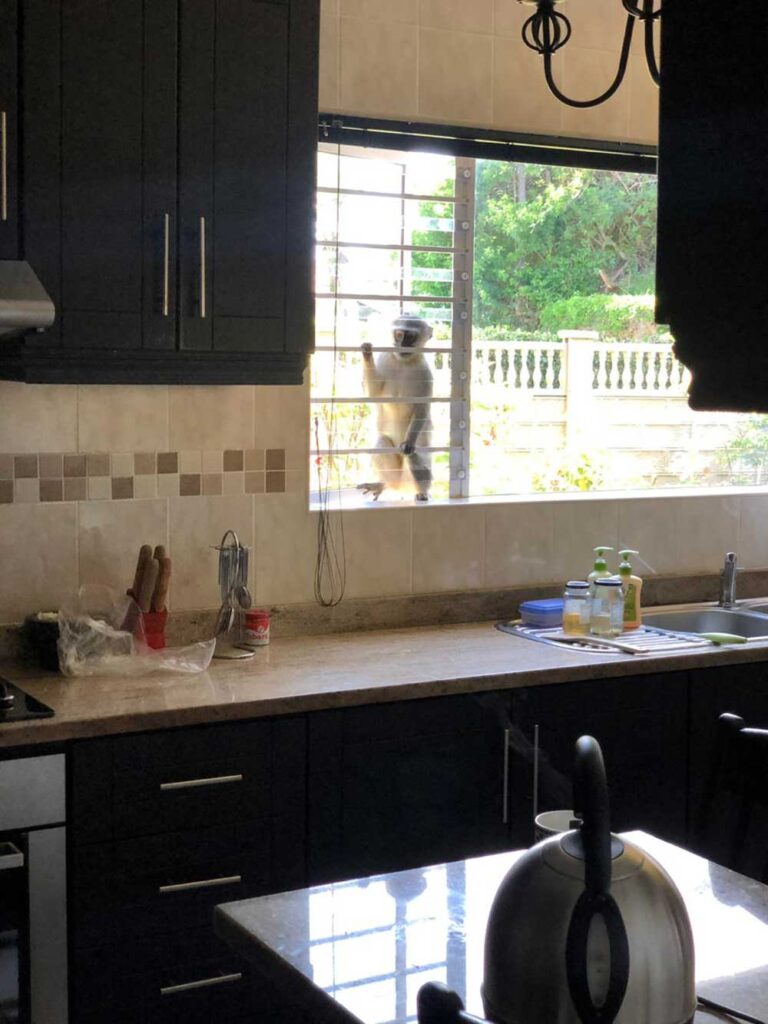
For properties in wildlife-prone areas, pairing your gate security with vervet monkey proofing solutions provides comprehensive protection against both human intruders and unwanted animal intrusions.
Weld Quality Inspection: The Standard That Prevents Failure
The difference between a sw ing gate that operates flawlessly for decades and one that fails within months lies in weld quality inspection. You’re investing in physical security, and that investment demands rigorous standards.
Your inspection process must follow these critical steps:
- Visual inspection within 24 inches of each weld at a 30° angle to detect cracks, undercut, and incomplete fusion
- Dimensional verification using fillet weld gauges and calipers to confirm leg sizes and throat thickness match specifications
- Non-destructive testing protocols, including radiographic inspection for primary tension welds and magnetic particle testing for major fillet welds
A 48-hour post-weld inspection catches delayed cracking in high-strength steels. All inspectors must document findings formally, marking non-compliant areas immediately. This diligence guarantees your swing gate security system performs reliably.
Grease Your Hinges and Test After Installation
Maintaining pristine hinge operation requires consistent lubrication and methodical post-installation testing to ensure your swing gate security system performs reliably for decades. Apply high-quality lithium grease or gate hinge oil using a grease gun with Zerk fittings on sealed bearing hinges. Clean the hinges thoroughly with a dry cloth and a stiff brush, removing dirt and any old, hardened grease before application.
After lubrication, cycle your gate open and closed 10–15 times to work the lubricant into the mechanisms. Listen for squeaking during operation, as this indicates areas needing additional attention. Wipe away any excess grease immediately to prevent it attracting dust and causing a build-up.
For home security in South Africa, schedule lubrication every 3–4 months in harsh coastal or high-traffic conditions. Annual maintenance is sufficient for standard residential installations. This disciplined approach ensures smooth, secure operation while protecting your custom-fabricated investment.
Troubleshoot binding, sagging and misalignment problems
Even minor issues with binding, sag, and misalignment can escalate into significant security failures if you don’t address them promptly. You’ll want to diagnose these problems systematically to maintain your gate’s performance and security integrity.
Follow these diagnostic steps:
- Inspect binding issues by checking gate movement for resistance, tightening all loose fasteners, and verifying smooth manual operation before automation engagement.
- Evaluate sag problems by assessing hinge capacity against gate weight, examining loose screws, and confirming your supporting column provides adequate rigidity.
- Correct misalignment by tightening all mounting hardware, verifying balanced movement, and checking sensor alignment.
Custom welded hinges eliminate weak points that loosen under vibration.
Properly engineered hinges guarantee stable, smooth operation without resistance.
You’ll achieve great results when hinges match your specific gate weight and size requirements.
Ready to give intruders the boot while welcoming in the fresh air? Swing into action and discover how sturdy swing gates for doors offer simple, track-free protection that operates just as easily as your normal entrance.