


Most heavy duty swing gates fail — not because of weak steel or cheap motors, but because installers overlook two critical details that turn a security asset into a liability. Structural reinforcement, motorised operators, and redundant sensors only matter when force-limitation settings and pinch-point guards are properly configured. Get these wrong, and your fortress becomes a crushing hazard. The difference between a gate that protects and one that injures comes down to specific standards most builders never examine.
Understanding Gate Entrapment Hazards and Safety Gaps
When you design or install a heavy-duty swing gate, addressing entrapment hazards isn’t optional—it’s fundamental to protecting the people who’ll use and live around the property.
Critical gaps pose serious risks. Openings between 3.5 and 9 inches allow a child’s body to pass while trapping the head, causing strangulation or positional asphyxia. You must eliminate all gaps exceeding 2.25 inches in automatic swing gates. Corner posts and rods can’t be spaced more than 2 3/8 inches apart to prevent leg-hole entrapment.
The statistics demand attention. Between 1990 and 2000, nearly 25,000 people suffered injuries related to automatic gates, with 9,000 being children under 15. The CPSC identified 32 deaths from 1985 to 2001, including 20 child fatalities. New safety standards now require at least two mechanisms to prevent entrapment, including a sensing device that reverses the gate when it encounters an obstruction.
Proper design eliminates these hazards entirely, protecting your property and everyone nearby. Gates built with robust materials and finishes further reinforce safety by ensuring structural components remain intact and resistant to wear that could otherwise create dangerous gaps or mechanical failures over time.
Structural standards that deter intruders and meet code compliance
The ability of a heavy-duty swing gate to resist intruders and withstand years of use depends on structural integrity that meets—and often exceeds—South African building codes.
You’ll want posts sized appropriately: a minimum 4-inch diameter for gates 4–8 feet wide, and 6-inch diameter for gates over 12 feet. A manual test observing post bending from the ground up during gate movement is a practical way to assess whether your post strength is adequate for the operator type you’ve selected.
Your door security depends on proper hinge ratings of at least 150% of the actual gate weight to safely handle dynamic loads.
Concrete foundations must achieve a minimum 3000 PSI strength, with a volume equal to 3–4 times the post cross-sectional area per foot of depth.
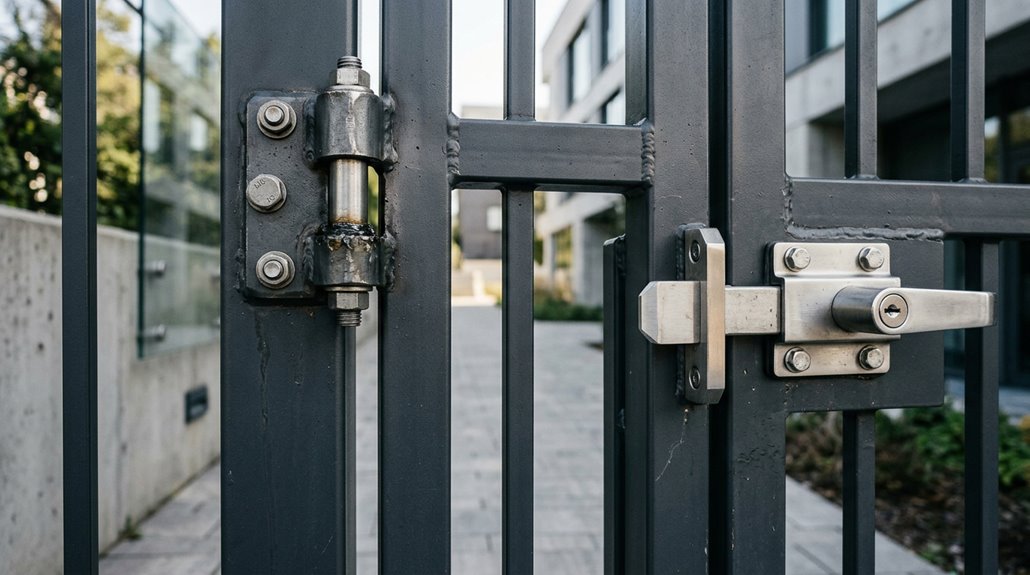
All hinge fittings require full-round welding to the framework. Suppliers using SABS and UKAS approved components ensure that welded fittings and structural elements meet independently verified quality standards from the outset.
Gates exceeding 3.2 metres in height require structural calculations submitted for Building Authority approval.
These standards ensure your installation resists forced entry while maintaining long-term reliability and compliance.
How force limitation systems prevent user injury
When you install a heavy-duty swing gate on your property, you’re relying on force limitation systems that detect impact instantly and respond within milliseconds to protect anyone nearby.
Your gate’s sensors monitor contact with obstructions and trigger immediate stops or reversals, while adjustable force settings ensure that impact forces stay below the 1400N threshold and crushing forces remain under 400N as required by safety standards. Pressure sensors integrated throughout the system continuously assess gate movement to ensure compliance with these critical safety parameters.
These systems reduce force to just 25N within five seconds, effectively removing entrapment hazards and preventing serious injury during gate operation. For comprehensive perimeter protection, pairing your gate with SABS approved materials in your window security installations ensures a consistently high standard of physical barrier safety across your entire property.
Impact Detection And Response
Modern heavy-duty swing gates incorporate sophisticated detection and response systems that work together to eliminate crushing hazards and prevent user injuries during operation. You benefit from multiple protective layers working seamlessly.
- Pressure sensors and infrared photo beams detect obstructions immediately, triggering instant stops or reversals when objects block the gate path.
- Photo eyes and safety edges identify pedestrians or vehicles, halting movement before contact occurs.
- Induction loops sense metal objects approaching the course, initiating safety protocols automatically.
These sensor technologies protect your front door security investment by responding within milliseconds. When dangerous situations are detected, gate cycles reverse depending on travel direction. In wind-prone areas, photoelectric sensors can experience false detections from strong gusts, potentially causing unintended stops or unexpected reopenings that may affect gate reliability.
Electromechanical limit switches precisely control stop points, preventing exceeded motion ranges. Your installation features responsive halting mechanisms that eliminate potential mishaps during movement, ensuring reliable protection for your property and users. For properties requiring tailored configurations, bespoke security solutions can be designed to accommodate unique structural features while maintaining full compliance with force limitation standards.
Force Reduction Within Milliseconds
Your heavy-duty swing gate’s ability to reduce force within milliseconds is the critical difference between a functional barrier and a genuinely safe one. Motor-integrated force limitation systems detect obstructions instantly through pressure sensors and infrared photo beams, triggering immediate deceleration.
When contact occurs, your swing gate safety depends on meeting strict standards: impact force must drop to 150N within 0.75 seconds and further reduce to 25N within 5 seconds. This rapid response prevents sustained injury risk.
Adjustable force settings regulate motion power, ensuring excessive impact never occurs. Proper calibration of these mechanisms keeps force below 1400N generally, or 400N in crush zones. These safety features use hydraulic, mechanical, or electronic operators to automate precise movement control and emergency stopping capabilities.
Your gate’s internal sensors work millisecond by millisecond to protect users while maintaining reliable security performance across installations in KwaZulu-Natal. Beyond automated force control, a free home security assessment can identify vulnerabilities in your gate setup and ensure every safety mechanism is correctly configured for your specific property.
Give your home a grand entrance that keeps uninvited guests strictly on the outside! Check out our master guide on Swing Gates for Doors to see how custom-welded strength can perfectly match your home’s classic style.
Crush Hazard Prevention Standards
Since heavy-duty swing gates can generate tremendous force during operation, crush hazard prevention standards exist to protect users and comply with rigorous safety regulations.
You’ll find that force limitation systems work by controlling the physical security barrier’s impact capacity.
Here’s how these standards protect you:
- Maximum crushing force of 1400N applies to gaps exceeding 500mm, while gaps between 50mm and 500mm allow only 400N
- Force must reduce to no greater than 150N within 750 milliseconds upon contact with an obstruction
- Photoelectric beams and pressure-sensitive safety edges detect obstructions and trigger immediate reversal
Your Wonder Bars heavy-duty swing gates incorporate these force limitation devices to guarantee compliance with BS EN 12453:2001 standards. Wonder Bars has completed over 4 000 installations, building the expertise required to integrate these safety mechanisms correctly across a wide range of residential gate configurations.
This measured approach delivers great results, protecting everyone accessing your property while maintaining aesthetic appeal alongside strong security performance. Automated gates can continue moving without direct human intervention, increasing the importance of these safety systems to prevent injuries during unexpected contact.
Guarding Pinch Points, Rollers, and Closing Edges Below 8 Feet
When a swing gate operates, multiple mechanical components move in ways that can trap hands, fingers, and clothing if they’re not properly protected. You’ll find pinch points at hinges, rollers, and in-running nip points—all requiring covers if they are located below 8 feet (2.5 m).
Your heavy-duty swing gate must have guards secured with tools, preventing accidental removal. Install vertical posts with electric sensing edges on both sides to block hand entrapment. Fixed guards covering guide rollers and sprocket drives greatly reduce crushing risks. Injuries occur faster than human reaction time, making physical barriers essential rather than relying on worker awareness alone.
Safety edges wired to stop the gate immediately upon contact thoroughly protect closing edges. You’re required to install protective screen mesh from the gate’s base to a minimum height of 6 feet (1.8 m), preventing a 2.25-inch sphere from passing through. Gate operators must reverse automatically if contact occurs. Bespoke craftsmanship in gate fabrication ensures that security components are manufactured to exact specifications, reducing mechanical gaps that create hazardous entrapment zones.
Building Your Quarterly Safety Inspection Checklist
Establishing a structured quarterly safety inspection checklist protects both users and your investment in heavy-duty swing gates. You’ll want to document critical maintenance activities systematically, ensuring compliance with UL 325 and ASTM F2200 standards. Digital documentation eliminates paper-based mistakes and confirms accountability throughout the inspection process.
Structured quarterly inspections protect users and your investment while ensuring UL 325 and ASTM F2200 compliance for heavy-duty swing gates.
Your inspection routine should cover:
- Structural integrity—examine hinges, welds, and concrete anchor points for cracks or corrosion
- Operational performance—test force characteristics at specified distances and verify that the gate stops within 2 seconds
- Safety systems—confirm photo-eye sensors, pressure bars, and entrapment protection function correctly
When implementing home security South Africa protocols, you should photograph defects, record findings, and note immediate repair recommendations. This documentation creates an audit trail demonstrating your commitment to safety standards. For tailored guidance on gate specifications and materials, you can request a free personalised quote to ensure your installation meets the requirements for your specific property.
Regular quarterly inspections catch wear early, prevent costly failures, and maintain the protective performance your heavy-duty swing gate delivers. Site-specific risks should be documented so that records align with PUWER and HSE guidance for compliance verification.
South African Security Gate Installation: Cost, ROI, and Property Value
Heavy-duty swing gates represent a substantial investment in your property’s security infrastructure, and understanding the financial implications helps you make informed decisions about protection and long-term value. Comprehending costs across the KZN region, including burglar bars KZN alternatives, helps you position yourself strategically in the market.
| Region | Manual Gates | Automated Systems | Installation Labour |
|---|---|---|---|
| Johannesburg | R9,000–R18,000 | R35,000–R42,000 | R2,500–R5,000 |
| Pretoria | R6,950–R15,850 | R18,000–R25,000 | R3,500–R8,500 |
| Gauteng Industrial | R13,950+ | R30,000–R80,000 | R470–R670/hour |
| KZN Residential | R15,000–R40,000 | R30,000–R80,000 | R3,500–R8,500 |
Custom-designed gates start at R30,000, rising depending on mechanisation and materials. Solar-powered automated systems reduce electricity costs significantly. High-quality construction extends the gate’s lifespan, minimising replacement frequency. Security upgrades directly improve a property’s marketability and resale value across South Africa.
Ready to give intruders the boot while welcoming in the fresh air? Swing into action and discover how sturdy swing gates for doors offer simple, track-free protection that operates just as easily as your normal entrance.