








Mesh barriers. Motion-activated sprinklers. Still losing the battle against vervet monkeys every single week. These primates aren’t just hungry—they’re strategically intelligent, mapping your neighbourhood like seasoned burglars who know exactly which homes roll out the welcome mat. Most homeowners keep throwing money at surface-level solutions while missing the one factor that actually determines whether vervets return. Understanding what draws them to specific properties changes everything about how you fight back.
Secure Your Barriers: Mesh, Bars, and Netting That Works
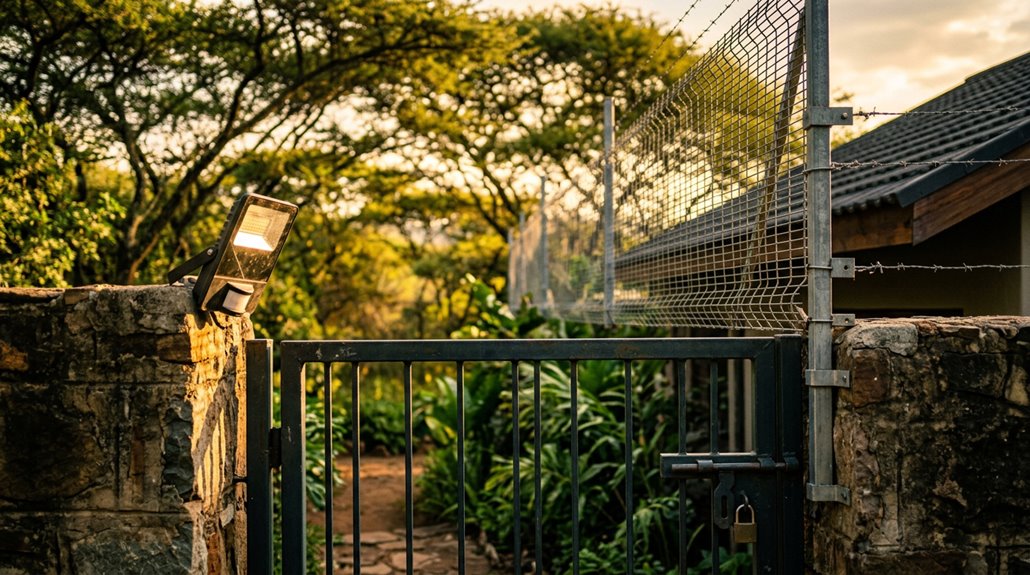
Protecting your home from vervet monkeys starts with understanding the physical barriers that actually work. Mesh openings must not exceed 38mm to block small primates effectively. You should use wire diameter of 1.6mm with 25–38mm apertures for optimal monkey-proofing. Plastic mesh on windows and security doors provides highly effective protection while maintaining airflow.
Install barriers at least 2.5 metres high to prevent monkeys from climbing over the top. Bury the mesh 30–50cm underground to stop monkeys from digging underneath. Nylon netting securely fastened around produce gardens denies aerial access to crops. Support structures must be well-anchored to resist primate force. Insect-proof screens on windows and doors keep vervets out of homes, offering convenient installation for most properties.
You can combine mesh with Clear View burglar bars for sturdy physical barriers. Mesh cat flaps deter vervets while initially allowing pet access. Removing movable flaps after habituation ensures monkeys don’t learn to exploit gaps. These layered approaches deliver great results across properties in KwaZulu-Natal. For homeowners seeking a fully tailored solution, bespoke monkey-proofing systems can be custom-designed to integrate seamlessly with your existing windows, doors, and home aesthetics.
Remove Food Before Monkeys Learn Your Address
Once vervet monkeys find a reliable food source, they’ll return repeatedly—and they’ll tell their troop mates where to find it. You’re effectively training them to target your home.
Remove all fruit, cereals, bread, and cakes from kitchen surfaces near windows and doors. Secure pet food and bird feeders well away from your residence. Keep leftovers in distant compost heaps, never visible to passing vervet monkeys.
Your waste management directly affects visitation rates. Use wheeled bins with clamped lids or secure refuse bins with vervet-proof clips. Don’t leave rubbish in plastic bags. Sprinkle Jeyes Fluid around bins to deter scent attraction. Remember that suburban gardens provide natural foods including fruits, berries, leaves, shoots and seeds that monkeys actively forage for when human food sources aren’t available.
Work with your neighbours on consistent food and waste routines. When you remove food sources before vervet monkeys establish patterns, you’ve eliminated their primary reason for visiting—achieving great results through prevention rather than confrontation. For properties where removing food alone isn’t enough, professional vervet monkey proofing can provide a reliable, humane barrier between monkeys and your home.
Repellents and scare tactics that actually deter
While removing food sources addresses the primary attraction, repellents and scare tactics form your second line of defence—creating an environment where vervets find your property unwelcoming and uncomfortable.
Natural repellents work effectively. Chilli pepper brews containing 5–10 peppers mixed with garlic and citrus peel create strong deterrent scents. Spray this solution directly onto plants, or dust curry powder and chilli powder across flower beds. Hot pepper sprays establish unpleasant barriers that discourage feeding. Allow the chilli pepper mixture to cool completely before transferring it into spray bottles for safe application around your property.
Scare tactics complement chemical deterrents. Motion-activated sprinklers startle monkeys and baboon deterrents through unexpected bursts of water. Realistic rubber snakes moved regularly prevent habituation. Loud noises from banging pots or ultrasonic devices create avoidance zones around your property.
Water-based methods are particularly effective. Garden hoses and water pistols push vervets away since they dislike being wet. Using combined approaches—repellents plus scare tactics—delivers great results for protecting your property.
For homeowners seeking a more permanent and structural solution, retractable windows and fixtures offer bespoke, high-strength barriers that deter intrusion while integrating seamlessly with your home’s existing design.
How to Stay Safe When You Encounter a Monkey
Despite your best preventive efforts, you may occasionally encounter a vervet monkey on your property or in your neighbourhood. Your response during these moments materially affects both your safety and the animal’s wellbeing.
Back away slowly while facing the monkey. Avoid direct eye contact, sudden movements, and loud vocalisations—these actions trigger defensive responses. Keep a passive body posture to show you are not a threat.
Back away slowly while facing the monkey, avoiding direct eye contact and sudden movements to prevent defensive responses.
Never try to catch, corner, or grab the animal. Don’t feed it by hand or from windows. Move away from the exit point and allow the monkey to leave freely. Staring or mimicking can be interpreted as a challenge, so remain calm and neutral throughout the encounter.
If a monkey enters your home, open doors and windows to allow it to escape. Use a water pistol or food lure to encourage it to leave. Consider investing in custom window security solutions designed to prevent future intrusions without requiring structural modifications to your home. For professional animal-proofing in Durban, contact the Monkey Helpline on 082 659 4711.
Why Vervets Come Back (And How to Stop It)
Once a vervet monkey discovers food on your property, it remembers that location permanently and returns again and again—a pattern reinforced each time it finds something to eat.
You are essentially training the troop through every unattended meal, pet food bowl, or accessible fruit tree, as monkeys quickly associate your home with reliable sustenance.
Breaking this cycle requires eliminating food rewards entirely, since even a single feeding event can establish a lifelong dependency that spreads through the social group.
This learned behaviour spreads rapidly because vervet monkeys live in social groups ranging from 10 to 70 individuals, and successful foraging discoveries are quickly adopted by other group members who observe and learn from their companions. Reinforcing your home with specialised monkey-proofing installations adds a critical physical barrier that removes access opportunities before learned foraging behaviour can take hold.
Habituation and Food Rewards
Your vervet monkey problem isn’t random—it’s learned behaviour reinforced by opportunity. When you leave food accessible, you’re not just feeding one monkey. You’re teaching an entire troop that your property offers reliable meals. This habituation changes the way vervets interact with your home fundamentally.
| Factor | Impact on Vervet Behaviour |
|---|---|
| Human food access | Reduces fear responses |
| Repeated positive encounters | Shrinks home range size |
| High-value food rewards | Decreases aggression |
| Habituation to humans | Increases curiosity |
| Ongoing food availability | Strengthens return visits |
Habituated vervets approach novel items more frequently than wild populations. They’re more likely to investigate your windows, doors, and barriers. Removing food sources directly addresses what draws them back. Secure waste, store pet food indoors, and eliminate bird feeders to protect homes effectively. Without rewards, vervets move elsewhere. Wonder Bars offers vervet monkey proofing solutions backed by over 21 years of experience, giving homeowners a reliable and lasting layer of protection. Physical exclusion barriers from Wonder Bars provide the permanent solution you need.
Breaking The Return Pattern
Start by eliminating food rewards immediately. Clear plates and scraps after outdoor eating, secure rubbish bins with latches or heavy rocks, and close kitchen windows and doors when monkeys are present. These steps remove visual and olfactory signals that break the association between your home and sustenance.
Active deterrence accelerates results. A jet of water from a hose encourages males to leave and seek other troops. Once relocated, males integrate into new groups and typically stop returning to previous locations.
Implementing these structural and behavioural strategies creates a great result: monkeys stop visiting your vervet area naturally through habit interruption rather than fear-based methods. For properties with persistent access problems, vervet monkey proofing solutions can provide a long-term physical barrier that prevents entry at key points around the home.
Get Your Neighbours Coordinated
Vervet monkeys don’t respect property lines, and neither should your neighbourhood’s defensive strategy. You’ll achieve great results by organising community coordination focused on home security South Africa standards.
Schedule regular meetings with neighbours to share monkey sighting reports, noting specific days and times of visits. This collective monitoring enables you to anticipate when to secure windows and doors across multiple properties simultaneously.
Establish a shared communication system—a group chat or email thread works well—for reporting incidents and entry points. Coordinate your barrier installations so that monkeys can’t simply move to unprotected homes nearby.
When neighbours work together on exclusion measures, you eliminate gaps in your collective defence. Assign responsibility zones where each household maintains its section of the perimeter. This unified approach turns your neighbourhood into an organised, monkey-resistant community. For properties requiring specialised entry solutions, professionally installed swing gates with locking systems provide an added layer of protection that monkeys struggle to bypass.