



Most front doors look secure. They’re not. A determined burglar doesn’t need explosives or special tools—just steady pressure and a few seconds. The real vulnerabilities aren’t where you think: it’s not the lock, it’s what surrounds it. Hollow cores, weak hinges, and screws barely an inch long are silently failing you right now. The good news? A handful of targeted upgrades can turn your front door into a genuine barrier that forces criminals to move on.
Why Front Doors Fail Against Forced Entry
When an intruder applies force to your front door, it’s usually the frame that fails—not the lock itself.
Your front door’s vulnerability comes from factory-standard components designed for convenience rather than security. Strike plates anchored with short 3/4-inch screws won’t penetrate structural wall studs, so the door jamb separates under pressure.
Standard hinges have removable pins, which let attackers lift your door completely off its frame. Thin strike plate material bends easily under concentrated kick-in force, undermining the lock’s effectiveness.
As doors age, warped frames or compromised timber provide minimal resistance to impact. Poor installation can cause frame flexing and gaps that tools exploit. One-piece strike plates distribute reinforcement across both the latch and deadbolt areas, removing separate weak points in the frame.
These connected weaknesses mean your front door fails at the structural level, not within the locking mechanism. By combining structural door reinforcements with bespoke security installations, every entry point is assessed and protected according to your home’s unique vulnerabilities and layout.
Reinforce the frame and jamb before upgrading the locks
Because most door failures occur at the frame/jamb rather than the lock itself, reinforcing your frame and jamb should be your first priority before upgrading to a high-security lock. Standard hinge screws—typically 3/4 inch long—do not reach the structural wall stud behind your door jamb, leaving this critical area vulnerable to splitting under impact.
Replace short screws with 3-inch case-hardened screws on the frame side and 2-inch screws on the door-side hinge leaves. Drill 3-inch deep pilot holes angled slightly towards the frame’s centre, applying cutting oil to prevent damage to the drill bit. Fit metal reinforcing plates or strike plate guards screwed into the jamb’s back to protect the wood around the deadbolt zone. Nine contact points on quality reinforcing plates distribute force across a wider area of the jamb, significantly improving resistance to impact.
This foundational reinforcement distributes brute force effectively, creating an excellent result that turns your entrance into a genuinely secure barrier. For a more comprehensive approach to protecting vulnerable entry points, pair door reinforcement with SABS and UKAS approved materials in window security installations to ensure consistent protection standards throughout your home.
Choose the Right Locks to Block Forced Entry
You’ll want to select ANSI/BHMA Grade 1 deadbolts with at least a 1-inch bolt throw for maximum resistance against forced entry attempts.
Dual-cylinder designs with five-pin tumbler mechanisms and anti-pick, anti-bump features—like those from Medeco or Abloy—provide significant protection against both brute-force and stealth entry methods. Combining a deadbolt with a high-quality handle strengthens overall entry security since old or damaged handles present easy breakage points.
Pairing a high-security mechanical deadbolt with a smart lock system offers you convenience while maintaining a backup layer of physical security that doesn’t rely on power or network connectivity. For properties requiring broader perimeter control, swing gates for doors provide an additional barrier that deters intruders before they ever reach the front door.
Grade 1 Deadbolt Standards
Most homeowners don’t realise that the lock on their front door carries an official performance rating, and that rating makes a tremendous difference in whether forced entry can be stopped quickly.
Grade 1 deadbolts represent the highest ANSI/BHMA performance benchmark available. They withstand 250,000 operational cycles before failure and pass a demanding 360 lb weight resistance test. This cycle capacity translates to approximately 27 years of durability at typical daily usage rates.
Grade 1 deadbolts survive six direct door strikes, whereas Grade 2 options endure only four strikes. Independent, BHMA-accredited laboratories certify these locks through rigorous testing—not manufacturer claims.
You’ll find a small “ANSI Grade 1” stamp on the lock body. Pairing a Grade 1 deadbolt with 3-inch strike screws delivers the greatest real-world security gain for your front door. For layered protection, combining high-grade locks with SABS and UKAS approved security door components further reinforces entry points against sustained forced entry attempts.
Dual-Layer Defence Mechanisms
While a Grade 1 deadbolt provides exceptional performance on its own, the most effective front door security relies on multiple independent locking mechanisms working together.
You strengthen your door security by combining several protective layers that work independently. If one mechanism fails, others remain functional.
Your dual-layer defence includes:
- Multi-point locking systems engaging at top, centre and bottom simultaneously
- Reinforced passive door leaves with flush bolts and floor-mounted anchors
- Heavy-duty hinges with non-removable pins preventing bypass attempts
- Security film or laminated glass protecting vulnerable panels
- Secondary surface-mounted bolts providing backup protection
This all-encompassing approach distributes forced-entry resistance across multiple points. You’re not relying on a single lock to stop intrusion. Instead, you’ve created redundancy that markedly increases the time and effort required to breach your entrance. The night lock with plate is recommended as the most important reinforcement for double doors, offering a barrier that barricades both doors while remaining removable for normal operation.
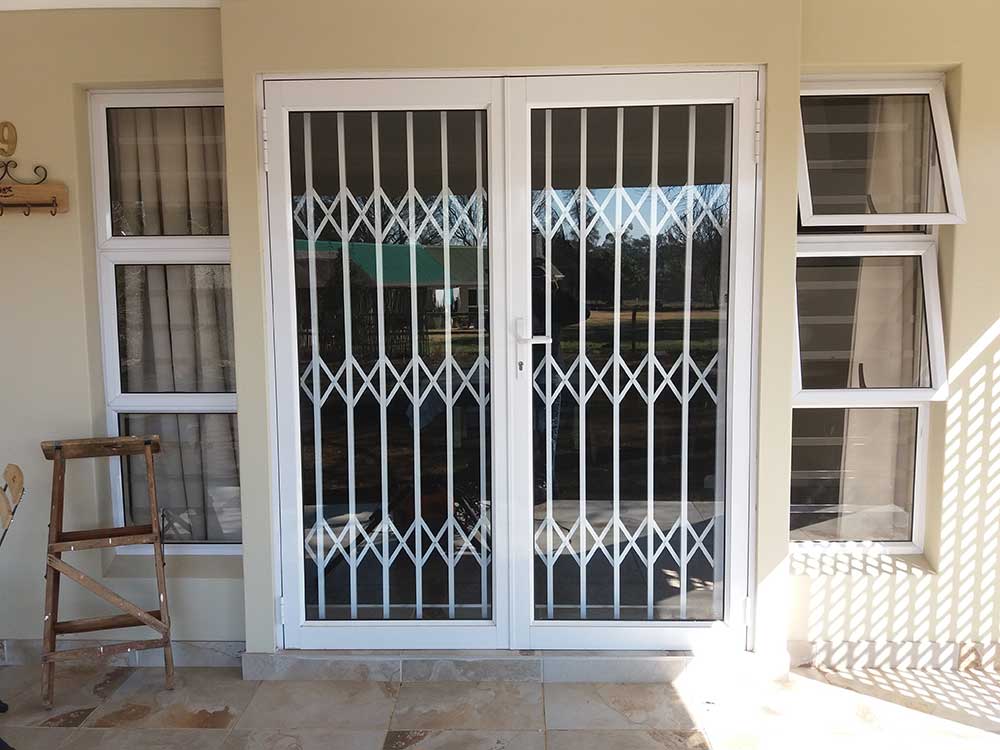
Wonder Bars fabricates these integrated systems, starting from ZAR 2,500 for basic configurations. For properties requiring additional access control across multiple entry points, retractable trellis doors provide a further layer of defence that complements your existing locking systems without compromising the aesthetic appeal of your entrance.
Smart Lock Security Features
Smart locks add a powerful technological layer to your front door’s defences, working alongside the mechanical systems we’ve discussed. These systems use AES 128-bit or 256-bit encryption to stop hackers from intercepting signals. Two-Factor Authentication (2FA) combining fingerprint recognition with PIN codes creates strong access control. Biometric scanners map over 80 fingerprint points in just 0.3 seconds for rapid verification.
Real-time tamper detection sends instant smartphone alerts if someone attempts interference. Built-in accelerometers identify unusual physical activity, triggering audible alarms. Access logs keep complete entry records, documenting all attempted entries. Professional installation and 24/7 monitoring provided through integrated security systems offer continuous oversight and rapid response.
When paired with quality burglar bars KZN installations, smart lock security features create all-round protection. Modern entry systems prevent 83% more break-ins than traditional mechanical locks. Auto-lock functions engage automatically after set periods, helping prevent accidental exposure. Battery systems last 3–5 years, ensuring continuous operation and reliable security monitoring.
A free home security assessment from qualified advisers can help identify the ideal smart lock and retractable fixture combination tailored to your property’s unique access points and vulnerabilities.
Protect Hinges and Door Edges From Prying
Your door’s hinges are vulnerable points that attackers exploit through prying, pin removal, and frame manipulation. Protecting them requires strategic upgrades and reinforcement. Wonder Bars delivers superior door security KZN solutions that fortify these critical areas without compromising aesthetics.
Door hinges are critical security vulnerabilities that attackers exploit through prying and pin removal, requiring strategic reinforcement and upgrades.
Strengthen your hinges with these essential upgrades:
- Replace standard hinges with non-removable pin (NRP) models and ball-bearing designs
- Install 4-inch hardened steel screws anchored deep into wall studs
- Fit hinge pin locks that prevent removal without a key
- Add metal hinge shields or guards covering the entire hinge area
- Position hinges on the interior side for complete inaccessibility
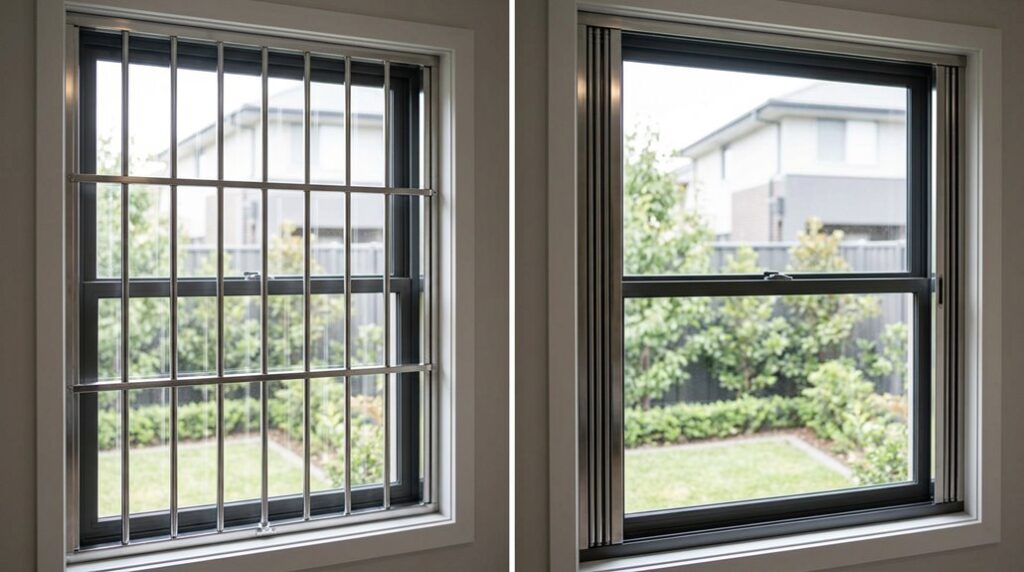
Proper alignment prevents gaps that weaken security. Inspect wooden frames and reinforce them with metal plates. Blocking pins installed between the frame and the door provide multi-point locking protection independent of the hinge mechanisms. For windows adjacent to entry points, cottage pane burglar bars offer custom-fabricated protection that integrates seamlessly with your home’s existing architectural character. These upgrades work together to create formidable barriers against forced entry attempts while maintaining your home’s designer character.
Upgrade to Solid Doors Built to Withstand Impact
Hollow-core doors crumble under forced entry attempts, but solid-core and steel alternatives create genuine barriers that stop intruders quickly. Steel doors are the strongest option available, resisting kicks, prying, and physical impacts through superior density and rigidity. Fibreglass doors with solid cores provide comparable security while offering excellent resistance to humid climates—a great result for home security applications in South Africa.
Your door’s material matters considerably. Impact-resistant doors withstand high winds and powerful impacts without splintering or blowing open, meeting rigorous testing standards including the Large Missile Impact Test. When installed with reinforced frames and impact-rated windows, these doors reduce the likelihood of home failure by more than 50% during worst-case scenarios. Multipoint locking systems on impact doors distribute force across multiple points, significantly increasing resistance to forced entry.
Replacing builder-grade hollow-core doors eliminates a critical vulnerability. You’re investing in a physical barrier engineered to remain closed and latched despite structural stress, stopping forced entry attempts before they succeed. For comprehensive perimeter protection beyond the front door, retractable trellis doors and burglar bars add layered security that significantly increases the difficulty of any forced entry attempt.
Combine Motion Sensors and Cameras for Layered Defence
You’ll dramatically improve your front door security by installing motion sensors and cameras that work together as a unified detection system. Real-time threat detection systems alert you immediately when movement occurs at your entry point, while strategically placed cameras capture clear footage of anyone approaching your property. This layered approach guarantees you’re never caught without visual confirmation and instant notification of potential threats. For properties in wildlife-prone areas, vervet monkey proofing solutions can be integrated with your existing security setup to provide dual protection against both animal intrusions and human threats.
Real-Time Threat Detection Systems
When motion sensors and cameras work together in a layered defence system, they create a thorough security network that catches threats faster than either technology alone. You’re protected by complementary technologies that detect forced entry attempts within seconds.
Here’s how real-time threat detection strengthens your front door security:
- Detection speed: Systems alert you within 2–3 seconds of abnormal activity
- AI accuracy: AI-CNN technology achieves 96% detection accuracy versus 82% for motion sensors alone
- False alarm reduction: Hybrid systems report only 3% false alarms through advanced filtering
- Automated response: Cameras trigger lights, sirens, and door locks automatically when threats emerge
- Smart notifications: Mobile alerts reach you instantly, enabling rapid intervention
You’ll appreciate the “Very Highly Acceptable” 4.60/5.00 reliability rating these integrated systems achieve. Your front door becomes markedly harder to breach when detection and response happen simultaneously.
Strategic Camera Placement Techniques
Real-time detection systems work best when cameras and motion sensors are positioned strategically throughout your property. You’ll integrate these technologies to create layered defence starting at your perimeter, through security gates, and into interior spaces. Motion sensors trigger immediate camera recording when activity occurs, capturing evidence while alerting you instantly.
| Location | Mounting height | Coverage angle |
|---|---|---|
| Front door | 8–12 feet | 15–30° downward |
| Security gates | 10–15 feet | Wide view |
| Driveway | 20+ feet | Broad coverage |
| Side entry | 8–12 feet | Direct approach |
| Interior hallway | 8–9 feet | Staggered zones |
You’ll eliminate blind spots by overlapping camera views, especially near corners and access points. This overlap ensures continuous monitoring without gaps, providing backup coverage if one camera becomes obstructed. Your motion detector zones define specific detection areas, preventing false alerts from pets while maintaining intruder detection capability.
Maximise Protection on Any Budget
Effective front door security doesn’t require a substantial investment—it calls for strategic choices that align with your circumstances and priorities.
You’ll find solutions at every budget level, from simple reinforcements to all-encompassing upgrades.
Budget-Friendly Starting Points:
- Replace 1-inch strike plate screws with 3-inch construction screws anchoring into wall studs
- Upgrade hinge screws to 3-inch variants securing directly into the door frame
- Install motion-activated exterior lights (R1400–R4200), deterring intruders from approaching
- Display security system signage on doors and lawns
- Apply security film to ground-level windows (R3500–R14,000+)
Mid-range investments such as Grade 1 deadbolts and Door Armor kits (R2100–R7000+) significantly improve protection.
Companies like Wonder Bars Durban specialise in custom security solutions that blend aesthetics with sturdy physical barriers.
Strategic reinforcements compound effectiveness without overwhelming your budget.
Looking for the perfect match? Finding the ultimate security fit for your doorway shouldn’t feel like standard guesswork. Explore our guide on how to secure your property with custom door security built precisely for your space.